Compassion: Any Act of Help is Never Too Little

I never really thought much of this incidence until we tackled the topic of compassion. The following is a personal story that occurred years before I took a Positive Psychology Program.

5 AM. After alighting the bus, I had my breakfast first and spent some time at Mcdonald’s waiting for the rain to thin out and waiting for the first ray of sun, before finding my way to my booked inn (which was like a good 20-minute walk from there). It felt so cold but after I ate I kind of warmed up a bit. Ha. Fuel was all I needed.
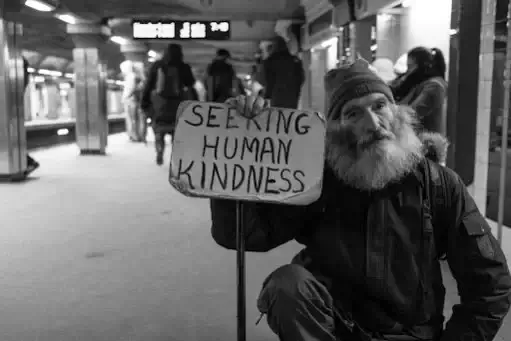
It was 6 am I think when the rain stopped and I went out. By the side of the road, was a blind man, he had a tin can in front of him, he was holding out his hands for alms. I never met my grandfather but I felt really disheartened by the sight of old people being left to the streets. Especially when I looked at his dysfunctional eyes. The weather was a bit chilly because it had rained and yet he had no jacket or anything thicker on him to keep him warm. I reckon he must be feeling cold, I did felt cold before I ate, and who would have known when this old man had his last meal?

Before you continue you might like to consider our free worksheet on exploring “Finding Joy In Life”. Please download this worksheet here.

In this article:
What is Compassion
Scientific Backed Benefits of Compassion
Any Act of Help is Never Too Little

He was feeling cold and kind of shaking, I realized as I was getting close. No one had given him alms yet. It was too early I guess. He was a good 40 steps ahead of my way and I realized that I just cannot stand walking past him and not giving a fuck so I went back and went into the small café near to get him a coffee and a club sandwich. Then I gave it to him.

He was thankful, of course. I told him to be careful with the coffee because it was still hot. He was smiling and that alone made my day. I know what I gave him wasn’t enough but hopefully, it starts and gets him for the day. Then I walked away. I was so damn close to tears.

I know how it feels to be helpless and no one even knows that you’re suffering. Or that they know it, they just don’t offer any support or help.

What is Compassion?

When we mention the word compassion, we relate the words: empathy, concern, and kindness. Truth is, compassion is empathy, concern, kindness, and action rolled into one. It is defined as a “deep feeling for and understanding of misery or suffering and the concomitant desire to promote its alleviation.”

As I was taking my Positive Psychology Certificate, I learned that it was just not me who was using compassion interchangeably with empathy. Empathy is defined as the ability to place yourself in another person’s shoes and feel their pain. Compassion goes beyond empathy and involves feeling an urge to take steps to relieve the other person’s suffering.

Why Do We Feel Compassion?

Some researches show that compassion is a learned or an innate tendency. Research by Cassell (2009) suggests that three requirements help drive feelings of compassion:

To put it simply, a person must first be aware of the real problem and not put the situation’s blame on the victim. Another is one must be able to picture ourselves in the same or similar situation.

The study by Cordon and DeSteno (2011) found that when participants felt compassion for one person, they were less likely to punish another participant for bad behavior.

One psychotherapeutic practice that uses compassion is the client-centered approach by Carl Rogers. According to Rogers, unconditional positive regard is a central part of the therapeutic relationship. The therapist is not just there to guide the client; he or she must also have genuine care and concern in a way that is both active and nonjudgmental.

Scientific Backed Benefits of Compassion

Compassion benefits the recipient of the kind or altruistic actions, but researches have found that compassion can have a wide range of psychological benefits for those experiencing this emotional drive.

Some of the major benefits of compassion to the self include:

Increased immunity: A study showed that practicing compassionate meditation gave participants a better immune response to stress.

More prosocial behaviors: Researchers have found that people who received short-term compassion training are more likely to engage in helpful, or prosocial, behaviors toward others.

Greater empathy for others: Even a brief period of compassion training showed that it can help people feel greater empathy or emotional understanding and urge action for others.

Increased happiness: Compassionate meditation has also been shown to help people become happier and healthier. Those who practiced this type of meditation rated themselves as happier and more satisfied with their lives.

Any Act of Help is Never Too Little

The next day, I went back to the spot where I first saw him. He wasn’t there. So I tried again on the third day, I was hoping to give the old man some company for a while since maybe all I can offer him is some time and maybe another meal. But he wasn’t there. I went around Session Road hoping maybe he’d be on the other side of the street. He wasn’t. I asked the lady who sold newspapers near the spot where I first saw him, and she had no idea since the man was not a regular on that spot.

I felt sad and happy at the same time. I don’t know where he is, and what happened to him after that fateful morning and that made me sad. But, I am joyful too that I was able to give him a little something, that I acted to care and helped him alleviate, momentarily, of the hardness in his life.

I offered what I could and it mattered.


Taking a Masters in positive psychology online program has shown me how significant and distinct the feeling of compassion is. Have you had any similar experiences with compassion? Would love to hear your stories too below!


Ready to cultivate more compassion in your life? Download our free ‘Finding Joy In Life’ workbook and learn how to deepen your empathy and take meaningful action for others.


WAIT!

Before you go, we'd like to give you a FREE workbook to support your journey 👇

Smiling woman with wavy brown hair wearing a navy blazer and white shirt, standing in a softly blurred office setting, conveying positivity.

Carolyn Freyer-Jones

Kickstart Your Coaching Practice

Highlights & Achievements:

Coach, facilitator, and contributor to coaching education. Carolyn is associated with practical coaching training and learning resources, supporting coaches and leaders in developing effective, ethical, and reflective coaching practices.
Man in a light blue shirt smiles gently at the camera. He has short, dark hair and stands against a blurred indoor backdrop, conveying warmth and approachability.

Rob Willson

Cognitive Behavioral Coaching

Highlights & Achievements:

Coach and educator contributing to leadership and coaching skills development. Rob is involved in professional training contexts, supporting the application of coaching tools and methodologies in organisational settings.
A woman with shoulder-length blonde hair is confidently posing with crossed arms. She wears a black and white checkered outfit and a necklace. The background is softly blurred, suggesting an indoor setting.

Prof. Ilona Boniwell

Positive Psychology Coaching

Highlights & Achievements:

Professor of Positive Psychology and Coaching Psychology. Ilona is a pioneer of applied positive psychology education in Europe and has founded and led postgraduate programmes in the field. Her work focuses on wellbeing, resilience, strengths, and evidence-based positive psychology interventions.
A middle-aged man with short gray hair and a beard wears a white turtleneck and a navy blue striped sweater, standing confidently indoors.

Jon Williams

Coaching for Performance

Highlights & Achievements:

Coach and contributor to professional coaching education and training programmes. Jon is involved in leadership and coaching development initiatives, supporting skill-building and reflective practice within organisational and coaching contexts.
A man in a blue suit and light blue shirt, with curly blond hair, smiles softly against a blurred, bright indoor background, conveying professionalism.

Prof. Erik de Haan

Relational Coaching

Highlights & Achievements:

Professor, executive coach, and leading expert in coaching supervision. Erik is widely recognised for his contributions to relational coaching, organisational development, and reflective practice, supporting both individual coaches and leadership systems worldwide.
Elderly man in a dark suit and striped shirt smiles warmly, standing in a bright, blurred background. The tone is professional and approachable.

Prof. Peter Hawkins

The Coaching Relationships

Highlights & Achievements:

Professor of Leadership and a leading authority in systemic team coaching and coaching supervision. Peter works internationally with boards, leadership teams, and organisations, and has written extensively on leadership, coaching culture, and systemic change.
Smiling older man in glasses and a light pink shirt sits indoors, with a softly blurred background of a modern, brightly lit office space.

Prof. David Clutterbuck

Goals

Highlights & Achievements:

One of the world’s most influential figures in coaching and mentoring. Professor Clutterbuck has authored and co-authored foundational texts in coaching, mentoring, and organisational development. His work has shaped global standards for coaching practice, supervision, and mentoring relationships.
A bald man in a dark, buttoned shirt with patterned cuffs stands indoors. He smiles subtly, with a bright, blurred background, exuding a calm, confident presence.

Devon White

Communication

Highlights & Achievements:

Coach and leadership development practitioner involved in contemporary coaching education. Devon has contributed to professional coaching programmes and discussions alongside established academics and practitioners in the coaching field.
Smiling woman with short auburn hair wearing a black dress and polka dot jacket. She stands confidently in a bright, blurred office setting.

Linda Aspey

The Coaching Relationships

Highlights & Achievements:

Coach, facilitator, and contributor to professional coaching education. Linda is recognised within the coaching psychology and leadership development community for her involvement in learning programmes, events, and reflective coaching practice.
A woman with short white hair smiles confidently, wearing a red blazer with a popped collar. The background is softly blurred, creating a warm, professional ambiance.

Dr. Chérie Carter-Scott

Psychological Foundations

Highlights & Achievements:

Executive coach, author, and pioneer in the coaching profession. Often referred to as “The Mother of Coaching,” Dr. Carter-Scott has been a leading voice in personal and professional development since the 1970s. She is a bestselling author and has trained coaches and leaders worldwide in motivation, leadership, change, and self-esteem.
Smiling man in suit with colorful tie stands in bright, blurred office. Hands clasped, he exudes confidence and warmth.

Prof. Jonathan Passmore

An Introduction to Coaching

Highlights & Achievements:

Chartered Psychologist, Professor of Coaching and Behavioural Change, executive coach, and author. Jonathan has published extensively in coaching psychology, leadership, and organisational change, including numerous academic articles and books. He bridges academic research and applied practice, contributing globally to coach education and evidence-based coaching.
Smiling man in a black suit and white shirt stands against a softly blurred, bright background. The atmosphere is professional and approachable.

Dr. D. Ivan Young

The Coaching Relationships

Highlights & Achievements:

Coach, educator, and thought leader in professional and relationship-focused coaching. Dr. Young is frequently featured alongside senior coaching scholars and practitioners in advanced coaching education and professional development settings, contributing to the evolution of reflective and relational coaching practice.
Smiling woman with short red hair wearing a blue blouse and earrings, standing in a softly blurred indoor setting, conveying a warm, professional tone.

Catherine Bell

Psychological Foundations

Highlights & Achievements:

Professional Certified Coach (PCC) and Master of Applied Positive Psychology (MAPP). Catherine specializes in leadership transitions, executive presence, and sustainable performance. Her work combines positive psychology, emotional intelligence, and strategic leadership development to help leaders thrive while maintaining wellbeing and purpose.
Smiling man in a navy blazer and shirt stands confidently with hands in pockets. The backdrop is a softly blurred office environment, conveying professionalism.

Yannick Jacob

An Introduction to Coaching

Highlights & Achievements:

Existential Coach, Positive Psychologist, Coach Trainer, and Supervisor. Yannick is the Programme Lead for the Accredited Certificate in Integrative Coaching at the School of Positive Transformation. He has taught coaching, positive psychology, and personal development at institutions including the University of East London, Animas Centre for Coaching, and The School of Life. His work integrates existential philosophy, coaching psychology, and human development to support meaningful change in individuals and leaders.
Compassion Any Act of Help is Never Too Little

Highlights & Achievements: