
Itai Ivtzan

Blame is the opposite of responsibility; it is attributing your misfortune to something or someone else to avoid taking responsibility for your actions. In one of my former articles I wrote about having a choice. Having a choice means that you recognise your own responsibility. Realising that your relationship with the moment stems from your own ego concepts changes your relationship with life.

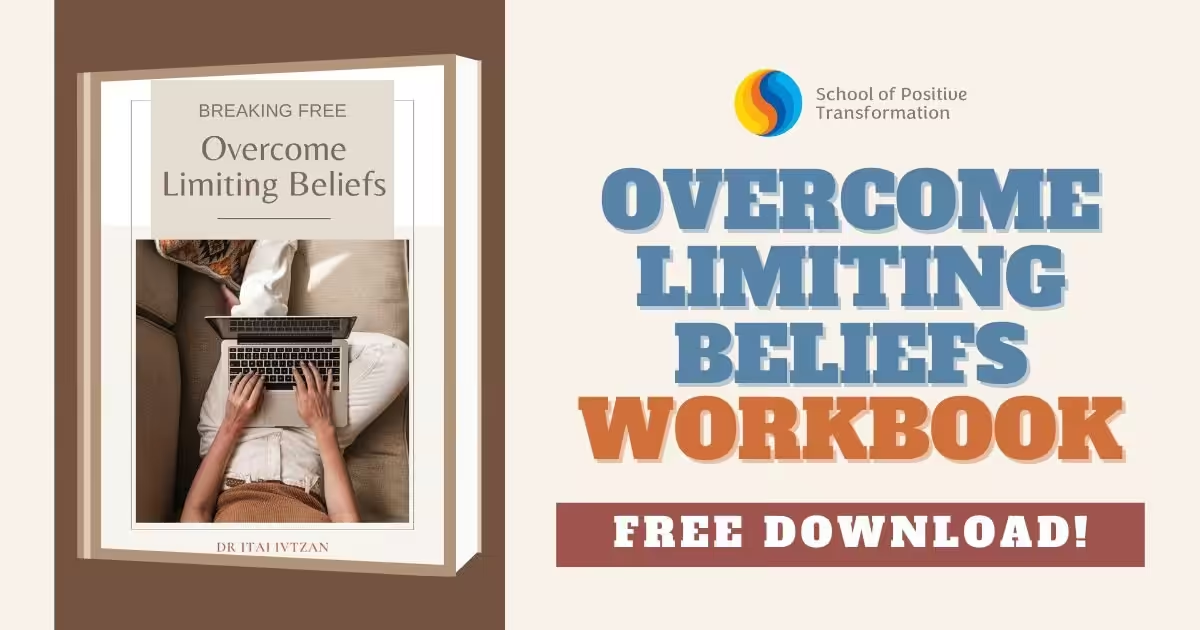
Before you continue you might like to consider our free worksheet on exploring “Overcome Limiting Beliefs”. Please download this worksheet here.

For this change to occur you must actually experience it, and regularly practice making this observation in order to link between your ego concept and your ensuing interpretation of the situation. Once you stop looking for external causes and realise that you are the source of your experiences, you begin taking responsibility for them. The yoga student, from my former article, who misunderstood the teacher, could point her finger at the teacher and gain nothing, or she could take responsibility and recognise her mind pattern and become aware of her own ego concepts of inferiority. You may ask: “What if the teacher actually meant to insult her? What if the person who made me uncomfortable really meant for this to happen?” In fact, what really matters is not whether the yoga teacher was being malicious or addressed the student innocently. The reaction (feeling hurt, for example) was triggered only because the student had an ego concept that was uncomfortable with who she was. If the student had been completely free of any inferiority-based ego concepts, then she would have simply smiled and continued to practice, no matter what the yoga teacher had meant, or she could have chosen to move on and leave the class. No reaction would have ensued because in order to set off a reaction a mind pattern had to exist that resisted the situation, and was in conflict with it.

Taking responsibility does not mean blaming oneself. Blame is just another ego concept. The mind, being in the habit of reacting automatically with an ego concept to any situation, frequently triggers another ego concept, that of guilt: “Oh, I shouldn’t judge!” or “This is so wrong, why do I expect that from him?” We are so accustomed to ego-concept-based-reactions that they easily sneak in through the back door.

By switching over from an external point of view (blaming others) to an internal one (recognising your own ego concept) you will be gaining a great benefit: you will be in control of the situation. As long as you blame someone or something else and hold them responsible, you can do absolutely nothing about the situation. No matter how hard you try, you will not succeed in changing the situation because the other person might not agree to make the change. This is the beginning of one of the most destructive processes in human relationships: trying to change others to suit our own understanding of the world, our own schemas. Whenever a certain situation conflicts with our schemas, we automatically attempt to reshape the situation in order to be comfortable again. Instead of letting go of the schema, we try to change the world to agree with it. This is where the idea of choice becomes very relevant; as we closely observe ourselves we realise that we can really choose between letting go of the schema (and accepting the situation as it is) or holding on to the schema but moving on and letting go of the situation that makes us uncomfortable.

Your schemas determine your motivations, whether you are aware of it or not. If something that happens in your life takes you by surprise, you are probably watching a motivation you were unaware of. Remember, an apple tree does not grow pears. If you see pears in the field of your consciousness, you are probably nurturing a pear tree. Most of us live in ignorance, that is, unaware of the seeds, the motivations, which we keep planting with our personal schemas. Taking responsibility means recognising the seeds we plant and realising that the fruit we eat, our experience, is a direct outcome of that original planting.

Dr Itai Ivtzan is passionate about the combination of psychology and spirituality. It makes his heart sing. He is convinced that if we befriend both psychology and spirituality resposibility, and succeed in introducing them into our lives, we will all become super-heroes, and gain super-strengths of awareness, courage, resilience, and compassion. Isn’t this an amazing prospect? His main areas of research are mindfulness, spirituality, and wellbeing. Dr. Ivtzan is confident that mindfulness meditation has the power to change individuals – in fact, whole societies – for the better. Accordingly, he has been investing much time in studying mindfulness academically, writing books about it, teaching it, and running mindfulness training for teachers and others. Offering the gift of mindfulness to others is a deeply rewarding experience; would you like to learn how to become a meditation teacher? Check out his mindfulness certification online to find out more.


Ready to take charge of your experiences and overcome limiting beliefs? Download our free ‘Overcome Limiting Beliefs Workbook‘ to start shifting your mindset and embracing responsibility for your actions today.
WAIT!

Before you go, we'd like to give you a FREE workbook to support your journey 👇

Smiling woman with wavy brown hair wearing a navy blazer and white shirt, standing in a softly blurred office setting, conveying positivity.

Carolyn Freyer-Jones

Kickstart Your Coaching Practice

Highlights & Achievements:

Coach, facilitator, and contributor to coaching education. Carolyn is associated with practical coaching training and learning resources, supporting coaches and leaders in developing effective, ethical, and reflective coaching practices.
Man in a light blue shirt smiles gently at the camera. He has short, dark hair and stands against a blurred indoor backdrop, conveying warmth and approachability.

Rob Willson

Cognitive Behavioral Coaching

Highlights & Achievements:

Coach and educator contributing to leadership and coaching skills development. Rob is involved in professional training contexts, supporting the application of coaching tools and methodologies in organisational settings.
A woman with shoulder-length blonde hair is confidently posing with crossed arms. She wears a black and white checkered outfit and a necklace. The background is softly blurred, suggesting an indoor setting.

Prof. Ilona Boniwell

Positive Psychology Coaching

Highlights & Achievements:

Professor of Positive Psychology and Coaching Psychology. Ilona is a pioneer of applied positive psychology education in Europe and has founded and led postgraduate programmes in the field. Her work focuses on wellbeing, resilience, strengths, and evidence-based positive psychology interventions.
A middle-aged man with short gray hair and a beard wears a white turtleneck and a navy blue striped sweater, standing confidently indoors.

Jon Williams

Coaching for Performance

Highlights & Achievements:

Coach and contributor to professional coaching education and training programmes. Jon is involved in leadership and coaching development initiatives, supporting skill-building and reflective practice within organisational and coaching contexts.
A man in a blue suit and light blue shirt, with curly blond hair, smiles softly against a blurred, bright indoor background, conveying professionalism.

Prof. Erik de Haan

Relational Coaching

Highlights & Achievements:

Professor, executive coach, and leading expert in coaching supervision. Erik is widely recognised for his contributions to relational coaching, organisational development, and reflective practice, supporting both individual coaches and leadership systems worldwide.
Elderly man in a dark suit and striped shirt smiles warmly, standing in a bright, blurred background. The tone is professional and approachable.

Prof. Peter Hawkins

The Coaching Relationships

Highlights & Achievements:

Professor of Leadership and a leading authority in systemic team coaching and coaching supervision. Peter works internationally with boards, leadership teams, and organisations, and has written extensively on leadership, coaching culture, and systemic change.
Smiling older man in glasses and a light pink shirt sits indoors, with a softly blurred background of a modern, brightly lit office space.

Prof. David Clutterbuck

Goals

Highlights & Achievements:

One of the world’s most influential figures in coaching and mentoring. Professor Clutterbuck has authored and co-authored foundational texts in coaching, mentoring, and organisational development. His work has shaped global standards for coaching practice, supervision, and mentoring relationships.
A bald man in a dark, buttoned shirt with patterned cuffs stands indoors. He smiles subtly, with a bright, blurred background, exuding a calm, confident presence.

Devon White

Communication

Highlights & Achievements:

Coach and leadership development practitioner involved in contemporary coaching education. Devon has contributed to professional coaching programmes and discussions alongside established academics and practitioners in the coaching field.
Smiling woman with short auburn hair wearing a black dress and polka dot jacket. She stands confidently in a bright, blurred office setting.

Linda Aspey

The Coaching Relationships

Highlights & Achievements:

Coach, facilitator, and contributor to professional coaching education. Linda is recognised within the coaching psychology and leadership development community for her involvement in learning programmes, events, and reflective coaching practice.
A woman with short white hair smiles confidently, wearing a red blazer with a popped collar. The background is softly blurred, creating a warm, professional ambiance.

Dr. Chérie Carter-Scott

Psychological Foundations

Highlights & Achievements:

Executive coach, author, and pioneer in the coaching profession. Often referred to as “The Mother of Coaching,” Dr. Carter-Scott has been a leading voice in personal and professional development since the 1970s. She is a bestselling author and has trained coaches and leaders worldwide in motivation, leadership, change, and self-esteem.
Smiling man in suit with colorful tie stands in bright, blurred office. Hands clasped, he exudes confidence and warmth.

Prof. Jonathan Passmore

An Introduction to Coaching

Highlights & Achievements:

Chartered Psychologist, Professor of Coaching and Behavioural Change, executive coach, and author. Jonathan has published extensively in coaching psychology, leadership, and organisational change, including numerous academic articles and books. He bridges academic research and applied practice, contributing globally to coach education and evidence-based coaching.
Smiling man in a black suit and white shirt stands against a softly blurred, bright background. The atmosphere is professional and approachable.

Dr. D. Ivan Young

The Coaching Relationships

Highlights & Achievements:

Coach, educator, and thought leader in professional and relationship-focused coaching. Dr. Young is frequently featured alongside senior coaching scholars and practitioners in advanced coaching education and professional development settings, contributing to the evolution of reflective and relational coaching practice.
Smiling woman with short red hair wearing a blue blouse and earrings, standing in a softly blurred indoor setting, conveying a warm, professional tone.

Catherine Bell

Psychological Foundations

Highlights & Achievements:

Professional Certified Coach (PCC) and Master of Applied Positive Psychology (MAPP). Catherine specializes in leadership transitions, executive presence, and sustainable performance. Her work combines positive psychology, emotional intelligence, and strategic leadership development to help leaders thrive while maintaining wellbeing and purpose.
Smiling man in a navy blazer and shirt stands confidently with hands in pockets. The backdrop is a softly blurred office environment, conveying professionalism.

Yannick Jacob

An Introduction to Coaching

Highlights & Achievements:

Existential Coach, Positive Psychologist, Coach Trainer, and Supervisor. Yannick is the Programme Lead for the Accredited Certificate in Integrative Coaching at the School of Positive Transformation. He has taught coaching, positive psychology, and personal development at institutions including the University of East London, Animas Centre for Coaching, and The School of Life. His work integrates existential philosophy, coaching psychology, and human development to support meaningful change in individuals and leaders.
Responsibility vs. Blame

Highlights & Achievements: